Athens and the Greek Islands Holiday Travel Guide.
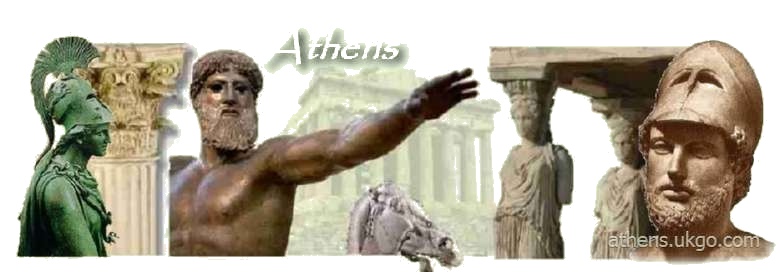
City of Athens Travel Guide. All about ancient and modern Athens.
Athens is a superb holiday city break, for those with an interest in the history of Greece. There are many hotels to choose, from ranging from budget class to the very best that Greece has to offer. From my own experience Hotel Phillipos is an ideal mid-range hotel, being so close to the Acropolis, just a few minutes walk, and providing a beautiful view of the Acropolis from the roof terrace. For central Athens the King George Palace Hotel in Syntagma Square is a top rated luxury hotel.
You will not struggle to pass your days away, not only are there the attractions of Athens monuments, museums, restaurants, nightclubs, churches and gardens but also the many day trips such as, the nearby islands of Aegina, Poros and Hydra, Cape Sounion and a ‘must visit’ trip to Delphi.
Nearby places to visit:
To the ancient Greeks Delphi, situated on the slopes of Mount Parnassus, was seen as the centre of the world, site of the oracle of the God Apollo. The Pythian Games took place every four years to honour Apollo, also music and poetry competitions, see the remains of the superb stadium and theatre. Breathtaking views can be seen all around Delphi. A long day trip from Athens. Take a packed lunch or visit one of the restaurants, some with outdoor areas providing beautiful views over the gulf of Corinth.
The Temple of Poseidon, Cape Sounion is one of the most famous and picturesque places in Greece with a magnificent view of the Aegean Sea. A nice half day trip from Athens passing the beaches of Athens.
Greek Islands near to Athens:
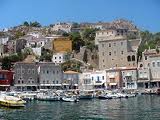
Hydra Island. Hydra town with its cobbled streets winding down among old mansions and restaurants, nestled around the clear-blue watered harbour, has to be one of the most beautiful sights in all of Greece. Hydra's popularity as a celebrity getaway Greek island and movie setting has not damaged its charm and reputation. An easy ferry trip from Athens. Hydra island was featured in the Alan Ladd and Sophia Loren film "Boy on a Dolpin".
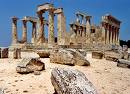
The island of Aegina is one of the islands in the Saronic Gulf, just outside Athens Greece. Many Athenians have summerhouses on this pretty island, Easy ferry trip from Athens. Visit the beautiful Temple of Aphaia giving superb views over Aegina Island.
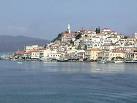
Poros Island is a small, beautiful volcanic little island. It is very close to Athens Greece, and is a popular summer resort to both Greeks and tourists. Easy ferry trip from Athens.
All three of these Greek islands can be visited in a one day trip from Athens.
The Main Greek holiday Islands.

Kos, Rhodes, Corfu, Crete, Mykonos
The history of the Greek Islands is, broadly speaking, the history of Greece.
Learn Greek online:
Athens videos.
 Athens, Greece
 The Acropolis
 Parthenon secrets
 Plaka in Athens
Ancient Athens, with it's abundance of historic monuments, is a favourite destination for tourists the world over. The most striking of all the sights being the Parthenon, the temple of Athena, patron goddess of Athens, sitting on top of the Acropolis, overlooking the modern city of Athens, the cradle of western democracy.
A virtual tour around the Acropolis of Athens.
Modern Athens.
In 1997 all the important ancient sites below the Acropolis of Athens were made easier to view by building a promenade that takes you around them. A walk up to the Acropolis is a must, but it is a bit of a climb, try to visit in the early morning or late afternoon when it is a bit cooler and less crowded, the light will also be better for taking photographs. The streets of Athens have been pedestrianised making the city more pleasurable to stroll around. The pedestrianised area around the Acropolis is formed by Dionysiou Aeropagitou and Apostolou Pavlou. Many cultural events are held. The Theatre of Herodus Atticus is a superb venue for musical, theatrical and dance performances. There are many guides and audiovisual equipment in English and Greek to help the visitor find and gain some knowledge of the sites. Begin your walk at the Athens metro stop. Follow Dionyssiou Areopagitou, the road that runs below the Acropolis. After a short while you will pass the New Acropolis Museum and then to your left the Theatre of Dionysus and Odeon of Herodes Atticus to your right. From here you can climb to the ancient Acropolis itself. The promenade will also give you access to other ancient sites of Athens, from the Temple of Hephaestus to the Ancient Agora.
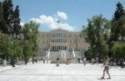 |
Syntagma Square is the home of much of the government of Athens. The neo-classical building dominating the square is the Greek Parliament which was once the Royal Palace. It is here that you will find the famous changing of the guard. There are several of Athens's best hotels located here. The King George Palace has a rooftop restaurant with superb views of the Acropolis. |
|---|---|
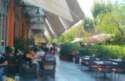 |
The Thissio neighbourhood of Athens, under the Acropolis, is named after the nearby temple in the Agora. It is very popular with Athenians and tourists alike with it's many outdoor restaurants and bars. |
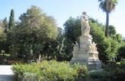 |
Nationals Garden and Zappeio Park. The National Garden is a lovely place to stroll, away from the traffic of central Athens. You'll come across peacocks, a children’s playground and a small zoo. If you turn right on entering the garden, you'll discover Zappeio Park, the centrepiece of which is Zappeion Hall. This building was originally built for the first modern Olympic Games. Now it's an exhibition hall. The National Garden is open sunrise to dusk. |
 |
The Athens Metro is one of the most beautiful in the world. When they were digging they had many delays due to them finding archaeological ruins. The metro plan was partly an archaeological dig as well as construction site. The result is a superb new metro which includes exhibits and finds from their digs, it is both museum and metro station. |
 |
Nightlife in Athens. The nightlife in modern Athens is vibrant. Athenians like a good party and do so most nights. Nightlife generally takes off after midnight for the bars and clubs and an hour or two earlier for tavernas and restaurants of which there are many to choose from. |
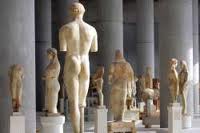 |
The New Acropolis Museum. The new museum, ten times larger than the original museum that was on the Acropolis, is now the superb new home for Athens most famous antiquities. |
 |
Athens is a paradise for shoppers, you will find everything from tacky souvenirs, excellent reproductions of ancient Greek statues, Greek art and authentic antiques and jewellery. Try the shops in the Plaka distict and the flea market in Monastiraki. |
Athens Walks. |
|
 |
Athens Walk 1: Begin in Syntagma Square, right in the heart of Athens. From here you will see the changing of the guard at the Parliament of Athens. Go through the National Gardens toward the Panathenaic Stadium. See Hadrian’s Arch and the Temple of Olympian Zeus then on to the Plaka district. Finish off by ascending the Acropolis and see The Parthenon, The Porch of the Maidens and the many other ancient monuments. If you have time finish off with a visit to the ancient Agora. |
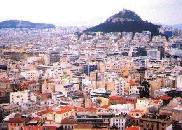 |
Athens Walk 2: Walk up Lycabettus Hill, or take the funicular. From her is the most magnificent view of the Acropolis and city of Athens. Visit the church of Saint George atop of the hill. When you descend take the metro to visit the National Archaeological Museum. There is much to see in the museum so give yourself an hour or two. |
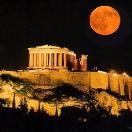 |
Athens Moonlight walk: Every August 55 of the ancient sites throughout all of Greece are open on the night of the August full moon. A romantic moonlight stroll below the floodlit Acropolis is a must. |
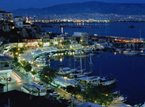 |
Take the metro to Piraeus for a stroll around the port of Athens, a good day out. There are plenty of restaurants, bars, shops and nightclubs around the harbour. There are also churches and a maritime museum. |
Ancient Athens. |
|
 |
The history of Athens is rich and varied. The occupation of Athens began around 3000 BC. It was not until the period between 1400 BC - 1200 BC that the remains we now see were built. Athens began on the Acropolis and gradually grew. Athens was one of the most powerful cities in Greece, both militarily and politically and was also first city to develop a democracy. |
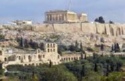 |
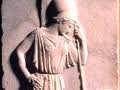
The Acropolis of Athens with the Parthenon, dedicated to the Greek goddess Athena, standing proudly on top, is one of the worlds most famous ancient monuments. When you ascend the Acropolis you know that you're about to see the worlds most famous temple. As well as the Parthenon you will encounter The Propylaea, The Erechtheum and The Temple of Athena Nike, perched on a platform on the south-west edge of the Acropolis of Athens. |
|---|---|
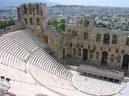 |
The theatre of Herodes Atticus is located on the southern slope of the Acropolis and was built during the Roman period of Athens between AD161-AD174. The theatre could seat up to 5000 spectators and is still used today for the performance of plays and musical events. |
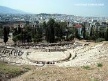 |
The Theatre of Dionysos was the first theatre to be built on the slopes of the Acropolis around 342BC-326BC. The theatre that you see today though was built in the Roman period and was used for gladiator and other blood sports. The theatre could hold up to 17,000. |
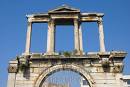 |
Hadrian's Arch: The Roman emperor Hadrian built a number of monuments in Athens, including this enormous triumphal arch with its huge Corinthian columns. Though Hadrian was a philhellene, he didn’t hesitate to use his arch to let the Athenians know who was boss: An inscription facing the Acropolis side reads 'this is Athens, the ancient city of Theseus'. On the other side it states 'this is the city of Hadrian, not of Theseus'. |
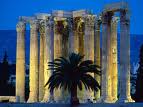 |
Temple of Olympian Zeus: Construction of the temple began in the 6th century BC at the site of the ruins of an earlier temple built by Peisistratus. The Temple stood unfinished throughout the Golden Century of Athens and was only completed by Hadrian, known as the Philhellene, in 132AD. The Temple was huge by ancient standards, rivalling other colossal famous Temples such as the Heraion in Samos, and featured a large gold and ivory statue of Zeus in its cella. |
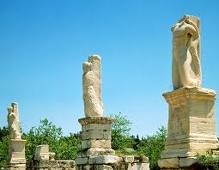 |
The Agora was the heart of the public life of Athens - its religious, political and commercial centre, where Athenian Democracy was born and flourished. The Agora provided a forum for social and cultural activity for the people of ancient Athens, commercial exchange, religious festivals, open-air theatrical performances and athletic contests. |
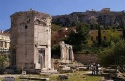 |
The Tower of Winds is found within the Roman Agora of Athens. It is an octagonal tower some 12 metres high and has a diameter of 8 metres and was built by the astronomer Andronikos. The tower was a water clock in the interior, sundial on the exterior and weather vane on the top. The eight sides represent the eight winds, carved on the outside. |
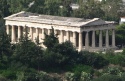 |
The Temple of Hephaestus, dedicated to the God of the forge, lies on the western edge of the Agora of Athens and was set among foundries and metalworking shops of ancient Athens. The Temple was one of the first of Pericles rebuilding of Athens programme. It is the best preserved of all the Doric Temples in Greece and still has it’s roof intact. |
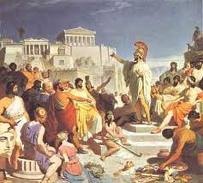 |
The Western Hills site covers 680,000 sq.m. to the west of the Acropolis. It was an important and densely inhabited section of Athens. The Pnyx is where the Assembly of the Demos, the principal institution of Athenian Democracy, was held. Philopappus Hill is crowned by the monument of the same name as well as a modern Observatory. |
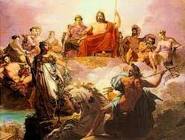 |
Greek Myths Gods and Goddesses. The ancient Greeks created their own splendid, but human-like world of Gods, justifying the various abstract significance's like Love, Birth or Death. |